
A tenant’s death does not automatically end their lease in California, and both landlords and families need to understand what happens next. Landlords need to know their legal obligations before they touch a single item in that unit, and families need to know their rights before a landlord tells them otherwise. AAA Crime Scene Cleanup works alongside both sides of this situation across Southern California every week, and this guide breaks down California law from both perspectives.
Does a tenant’s death automatically end the lease
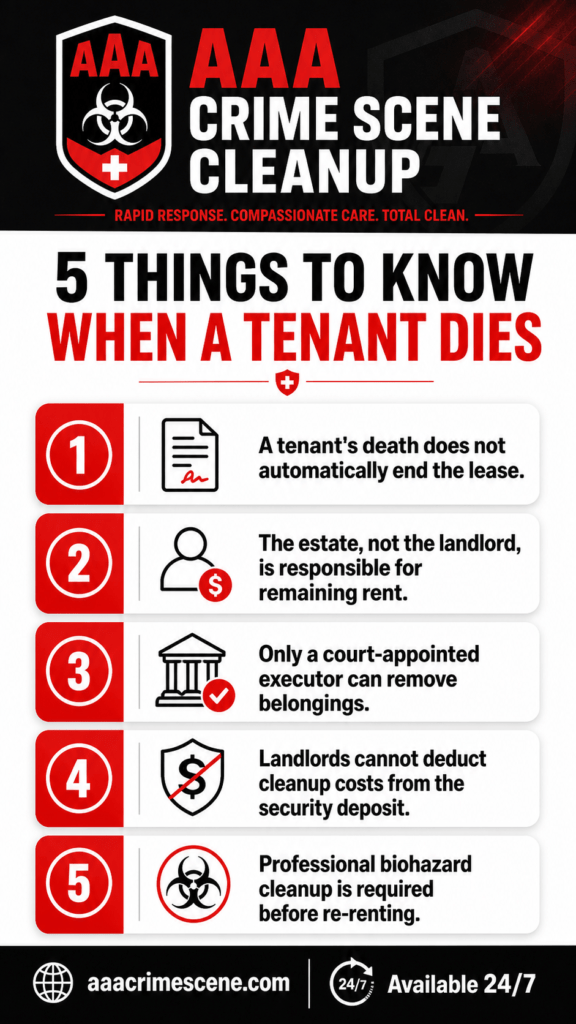
No, a tenant’s death does not automatically terminate a lease in California, and that surprises a lot of people on both sides of this situation. Under California Civil Code Section 1934, a month-to-month tenancy legally ends 30 days after the deceased tenant’s last rent payment, and the landlord doesn’t need to serve a separate 30-day notice to make that happen. Fixed-term leases work differently, and this is where confusion causes real problems. If the tenant was under a fixed-term lease, the estate remains responsible for rent through the end of that term unless the appointed executor formally returns possession of the unit to the landlord. Families should know this upfront, since assuming the lease “just ends” with the death can leave an estate on the hook for months of rent it never planned for. Other states handle this differently. New York, for example, only recently changed its rule when Governor Hochul signed a law in November 2023 allowing leases to be terminated upon a tenant’s death, a right that simply didn’t exist in New York before that date.
Who becomes responsible for the remaining rent
The deceased tenant’s estate becomes responsible for the lease obligations, not the landlord, and not automatically the surviving family members. On a fixed-term lease, that responsibility continues until either the lease term expires naturally or the estate’s executor formally surrenders the unit back to the landlord. For landlords, this means the estate’s executor is the person to identify and contact as quickly as possible, since nearly every next step in this process runs through that relationship. For families, this means the person handling the estate, often a spouse, adult child, or court-appointed representative, needs to understand they’re now the one legally responsible for resolving the lease, not just cleaning out a loved one’s things. This pattern holds true across most states. Under New York’s Section 236-a, for instance, the estate remains liable for rent and any debts incurred prior to the date the lease is formally terminated, which mirrors how California treats fixed-term obligations.
Who has legal authority to remove the tenant’s belongings
Only the court-appointed executor or administrator of the estate has legal authority to remove the deceased tenant’s belongings from the unit. Landlords cannot legally enter the unit and clear out personal property on their own, even if a family member is asking for quick access to grab a few things. Families should also know this cuts both ways: even close relatives generally don’t have automatic legal authority to remove items until an executor is formally appointed, which can feel frustrating during an already painful time. This process exists to protect everyone involved, since the executor carries a fiduciary responsibility to account for what happens to every item in the estate, preventing disputes among family members later. A landlord also cannot immediately evict a deceased tenant’s remaining family members from the unit without going through the proper legal eviction process, according to Estate Law Manhattan’s overview of tenant death situations, a protection that applies broadly beyond just New York.
What landlords should do right now
If the death was unattended or involved any kind of trauma, the very first step is not entering the property without written law enforcement clearance. From there, landlords should contact their insurance carrier immediately and document that call, since most standard California insurance policies include provisions for trauma scene remediation as part of dwelling or liability coverage. Getting the estate executor’s contact information should happen as soon as one is appointed. Calling a certified biohazard remediation company to assess the scope before any other contractor enters the unit protects the landlord from liability and ensures the space is handled according to state law. Our page on navigating legal requirements in homicide cleanup goes deeper into exactly what that process looks like. Throughout all of this, starting a paper trail matters more than most landlords expect, since every phone call, email, and document tied to the incident protects them if a dispute comes up later.
What families should do right now
Families facing this situation should focus first on getting an executor or administrator formally appointed, since almost nothing else can legally move forward without that step. Once appointed, the executor should contact the landlord directly, request written confirmation of the lease terms, and begin the process of either surrendering the unit or continuing the tenancy if that makes sense for the estate. Families should also know they are entitled to reasonable access to retrieve belongings once an executor is appointed, and a landlord cannot indefinitely block that access. Under federal housing regulation 24 CFR 891.435, even a deceased tenant’s interest in a security deposit is governed by state or local law rather than left to a landlord’s discretion, which underscores how much of this process is dictated by clear legal rules rather than informal arrangements. If the death involved trauma or was unattended for any period of time, families should not attempt to enter or clean the space themselves, both for safety reasons and because doing so before law enforcement clears the scene can create legal complications.
Can a landlord deduct cleanup costs from the security deposit
No, and this is one of the most common mistakes landlords make, and one families should watch for too. Some landlords mistakenly believe they can deduct cleanup costs from a tenant’s security deposit, but this approach rarely holds up legally in California and can expose the landlord to liability instead of protecting them. Cleanup costs tied to a death or trauma scene are typically treated as a property maintenance issue, similar to fixing a broken water heater or addressing mold, not as tenant-caused damage that can be billed against a deposit. Families should know this too, since a landlord attempting to withhold a deposit on these grounds may not have a legal basis to do so. This pattern shows up outside California as well. In New York, a landlord cannot legally retain a security deposit simply because a tenant died; the deposit must be returned to the estate unless there is unpaid rent or documented damage beyond normal wear and tear. California law requires landlords to maintain habitable living conditions in every rental unit, and that duty includes properly addressing biohazard contamination regardless of how it happened. A landlord cannot leave a unit contaminated, and they also cannot force a remaining tenant or the deceased tenant’s family to handle the cleanup themselves.
What California law requires around disclosure
California Civil Code Section 1710.2 requires landlords to disclose a death that occurred in a rental unit to any prospective tenant for three years following the death. That disclosure must include how the tenant died, if known, with one specific exception: deaths related to HIV or AIDS are excluded from the disclosure requirement entirely. This matters for landlords planning to re-rent the unit, and it’s worth families knowing too, since it shapes how quickly and honestly a unit can be marketed again.
Insurance and the cleanup process
Many landlords don’t realize their standard property insurance may cover a significant portion of trauma scene cleanup costs. Most California policies include provisions for crime scene cleanup or trauma scene remediation as part of dwelling or liability coverage, which can meaningfully offset what would otherwise be an unexpected expense. Families dealing with the estate side of this should also ask whether the deceased tenant carried any renters insurance, since that policy may separately cover damage to their own belongings. Getting this process right requires working with a company that understands both the cleanup itself and the documentation insurers require to process a claim smoothly. This is exactly the kind of situation AAA Crime Scene Cleanup handles every day, coordinating directly with insurance carriers on behalf of landlords and staying in respectful communication with families throughout the process. Our biohazard cleaning services page covers what that remediation process actually looks like once the lease and belongings situation is resolved.
What happens next for everyone involved
Once the lease situation is resolved between the landlord and the estate, and belongings have been properly addressed by the executor, professional cleanup needs to happen before the unit can be legally re-rented. This isn’t a step either side should try to shortcut. California requires trauma scene work to be performed by properly certified professionals, not a general cleaning crew, regardless of how eager everyone is to move forward. If you’re a landlord or a family member navigating this situation right now, reach out to AAA Crime Scene Cleanup directly. We’ll walk you through what happens next, coordinate with insurance where needed, and make sure the unit is handled with the care and compliance this moment deserves.